In today's distributed healthcare environment, seamless data exchange isn't optional—it's essential. Providers need complete, accurate, real-time information flowing across clinics, hospitals, labs, imaging centers, pharmacies, telehealth platforms, and billing systems. When interoperability is missing, workflows slow down, clinical risks increase, and patient outcomes decline.
MedTec is built with interoperability at its core—not as an add-on, but as the foundation of the platform. With standardized data exchange formats, modern APIs, and fully integrated clinical workflows, MedTec empowers organizations to deliver coordinated, efficient, and patient-centered care.
In this post, we break down what interoperability really means in EHR systems, why it matters more than ever, and how MedTec is advancing proper connectivity across the care continuum.
What Is Healthcare Interoperability?
Healthcare interoperability refers to the ability of different EHRs, systems, devices, and applications to securely exchange, interpret, and use health data across the full care continuum. In practice, this means information can move smoothly between provider organizations, diagnostic services, virtual care platforms, and administrative systems—without manual workarounds or data loss.
The Three Levels of Interoperability
-
Foundational Interoperability:
The most basic level—one system can send data to another. It enables simple data transmission but does not guarantee structure or shared meaning.
-
Structural Interoperability:
Data is exchanged in a standardized, organized format (such as HL7 or FHIR) that preserves meaning and allows systems to interpret information consistently.
-
Semantic Interoperability:
The highest level—systems understand and use the data the same way by relying on standardized clinical vocabularies such as SNOMED CT, LOINC, and RxNorm. This level supports accurate analytics, clinical decision support, and automation.
When these three levels work together, providers gain a unified, comprehensive view of the patient's care journey, enabling safer decision-making, faster workflows, and more coordinated care delivery.
Why EHR Interoperability Matters Now for Modern Healthcare
Growing System Complexity
As healthcare delivery becomes more complex, the ability to link disparate systems becomes essential. Modern care involves multiple touchpoints:
Without interoperability, data becomes fragmented, workflows break down, and providers lack critical information.
Risks of Poor Interoperability
Without interoperability, patient data remains fragmented, which leads to:
-
Duplicative testing or procedures
-
Care coordination breakdowns
-
Poorer patient experience
Industry Insights & Risks
National reports from the U.S. Office of the National Coordinator for Health Information Technology (ONC) show that although about nine in ten U.S. non-federal acute care hospitals had 2015 Edition certified EHR technology, only 55% can perform all four core interoperability functions—sending, receiving, finding, and integrating data from external providers. More than 70 percent of hospitals reported challenges exchanging data across different vendor platforms, along with ongoing difficulties matching patients and continued reliance on fax-based workflows, all of which still limit seamless data sharing.
Economic models suggest that nationwide, interoperable health information exchange and networked EHRs could save the U.S. healthcare system an estimated $78–81 billion annually, mainly by reducing duplicate testing and improving the efficiency of information sharing.
Without effective interoperability:
-
Patient records may be incomplete or inaccessible when needed.
-
Providers may not have full context (medications, labs, imaging, prior visits).
-
Workflow inefficiencies creep in (manual data re-entry, faxing, couriering).
-
Regulatory/compliance risk increases (data gaps, privacy exposures).
-
Organizations fail to realize the full promise of value-based care.
How MedTec Delivers End-to-End Interoperability
At MedTec, interoperability isn't an add-on—it's the foundation of the platform. Every feature is built to ensure data moves securely, accurately, and instantly across the entire care ecosystem. Here's how MedTec delivers true, end-to-end connectivity.
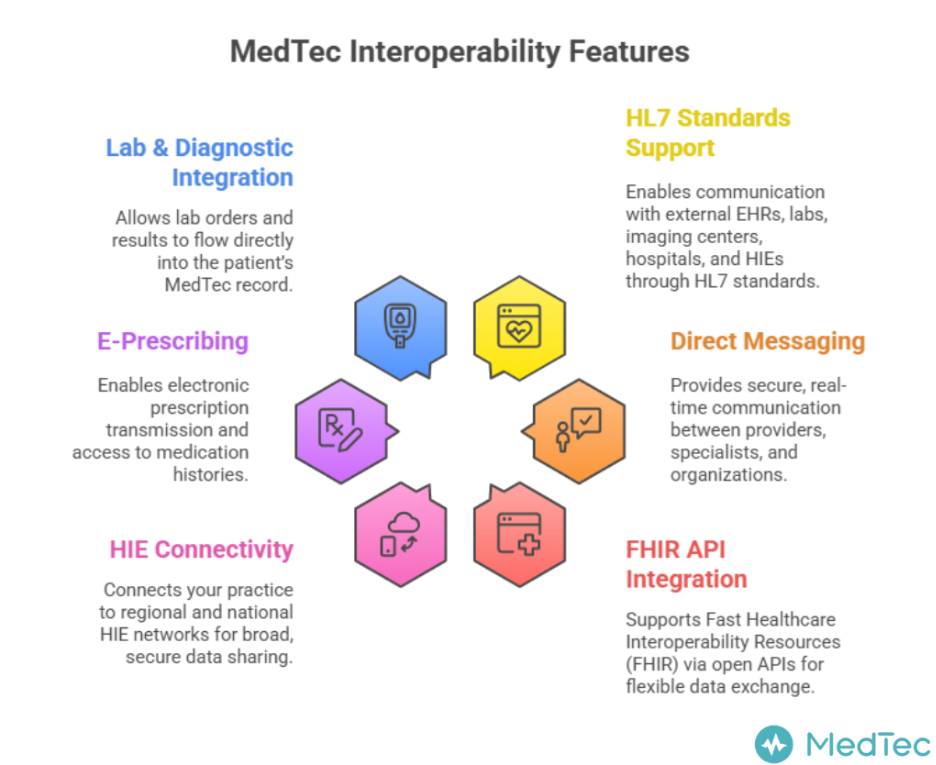
HL7 Standards Support
MedTec's support for Health Level Seven (HL7) standards ensures seamless communication with external healthcare systems and EHRs. This enables reliable data exchange with labs, imaging centers, hospitals, and health information exchanges (HIEs).
Outcome: Fewer manual processes, reduced transcription errors, and higher data accuracy across all care settings.
Direct Messaging
Secure Direct Messaging is built into MedTec, enabling real-time communication between providers, specialists, and organizations.
Why it matters: Faster referrals, smoother care transitions, and immediate access to shared information—all of which improve collaboration and patient outcomes.
FHIR API Integration
MedTec fully supports Fast Healthcare Interoperability Resources (FHIR) through open APIs, enabling high-speed, standardized data exchange.
Benefits include:
-
Easy integration with mobile apps, portals, and remote monitoring tools
-
Rapid onboarding of third-party applications
-
A scalable, future-ready architecture for evolving interoperability needs
Health Information Exchange (HIE) Connectivity
MedTec securely connects with regional and national HIEs, enabling your practice to become part of a broader connected care network.
Impact: A more complete view of each patient's history, stronger transitions of care, and improved population health management.
E-Prescribing
MedTec's e-prescribing capabilities are tightly integrated into the platform's interoperability layer. Providers can transmit prescriptions electronically, access medication histories, and reduce the risk of adverse drug interactions.
Result: Faster workflows and safer medication management for patients.
Lab & Diagnostic Integration
MedTec seamlessly integrates with laboratories and diagnostic centers, allowing orders and results to flow directly into the patient's record—no manual uploads, no delays.
Advantage: Faster access to critical results, fewer errors, and better-informed clinical decisions.
Additional Interoperability Features
Aligned with MedTec's full platform capabilities, the solution also supports:
-
Patient portal integration
-
Immunization registry reporting
-
Continuity of Care Document (CCD) exchange
-
Billing and revenue cycle connectivity
Together, these capabilities create a complete interoperability ecosystem—ensuring your practice delivers coordinated, efficient, and insight-driven care.
Key Benefits of EHR Interoperability for Your Practice
Choosing a truly interoperable EHR like MedTec enables your organization to achieve:
Full access to longitudinal patient data helps providers make informed decisions, reduce clinical risk, and deliver safer care.
-
Reduced Administrative Burden
Streamlined workflows, fewer manual entries, and automated data exchange minimize time spent on reconciliation and corrections.
-
Cost Savings & Operational Efficiency
Eliminating duplicate tests, accelerating referrals, and reducing delays lead to meaningful financial savings and smoother operations.
-
Improved Compliance & Reporting
Built-in support for immunization registries, CCD exchange, and HIE participation ensures audit-ready, regulation-aligned workflows.
Modern FHIR APIs and standards-based architecture allow you to adopt new tools, integrate emerging technologies, and scale with evolving care models.
-
Stronger Care Coordination
Secure messaging, shared records, and integrated communication tools support more seamless transitions across specialties and care settings.
Why MedTec Is Your Trusted Interoperability Partner
Choosing MedTec means choosing more than an EHR—you're choosing a partner committed to connected, efficient, and standards-driven care. Here's what sets MedTec apart:
-
Standards-Based Architecture
MedTec supports HL7 interfaces, FHIR API integration, Direct Messaging, HIE connectivity, and seamless lab and diagnostic integrations—delivering interoperability across the full care continuum.
The platform reduces workflow friction, strengthens provider communication, and supports faster, more coordinated care delivery.
-
Scalable for Any Practice
Whether your organization is a small specialty clinic or a multi-site practice, MedTec's interoperability capabilities adapt to varied workflows, volumes, and growth.
-
Guided Implementation & Support
MedTec assists your practice through setup, integration, and workflow alignment to help you get the most out of your interoperability features.
-
Thoughtfully Built with Best Practices
While interoperability is at the core of MedTec's design, the platform is developed in accordance with modern healthcare standards and practices to ensure responsible, reliable data exchange across connected systems.
Real-World Use Case: How Interoperability Transforms Care
Imagine a multispecialty practice using MedTec's fully interoperable EHR:
-
A patient visits their primary care provider (PCP). A specialist referral is sent instantly through Direct Messaging.
-
The specialist receives structured patient data in real time via MedTec's FHIR APIs and HL7 connections—no faxing, no delays.
-
Lab orders are automatically routed to the connected diagnostic center, and results flow directly into the patient's record.
-
The patient's immunization status is reported automatically to the state registry.
-
A telehealth follow-up is scheduled through MedTec's integrated virtual care module, with all records unified across encounters.
-
Billing and claims are processed smoothly because the EHR connects directly to the revenue cycle system.
The result: faster, safer care transitions; reduced administrative burden; improved patient experience; and stronger coordination across the entire care continuum.
Conclusion
As healthcare becomes more interconnected, seamless data exchange is essential for safe, efficient, and coordinated care. MedTec's standards-driven interoperability—HL7, FHIR, Direct Messaging, HIE connectivity, lab and diagnostic integration, and more—gives your organization the tools to eliminate data silos and support truly connected care.