Pain management is one of the most challenging and essential areas of clinical care. Patients dealing with acute or chronic pain often face significant barriers that diminish their quality of life, while providers must coordinate complex treatment plans to offer meaningful relief. Chronic pain affects an estimated 50 to 100 million adults in the United States, making it the leading cause of disability. Yet, despite its prevalence, studies suggest that up to 70% of pain patients are either undertreated or overtreated—clear evidence of gaps in care quality. Fragmented documentation, inconsistent treatment tracking, and trial-and-error care approaches all contribute to these shortcomings.
These longstanding issues highlight the need for purpose-built technology that supports the unique demands of pain care. MedTec 's specialized pain management Electronic Health Record (EHR) system is designed specifically to meet these needs. By providing tailored digital workflows, advanced clinical decision support, and pain-specific assessment tools, the system enables clinicians to deliver safer, more personalized, and more efficient care. This article examines how MedTec's pain management EHR elevates patient outcomes, optimizes daily operations, and equips pain specialists with the technology required to deliver high-quality, coordinated treatment.
The Unique Challenges of Pain Management
Managing pain is rarely straightforward. Pain is subjective and influenced by biological, psychological, and social factors, often requiring multidisciplinary care involving medication management, interventional procedures, physical therapy, and behavioral support. Providers must also document extensive histories, track pain progression, and monitor treatment responses over time—tasks that demand detailed, organized, and easily accessible records. On top of that, strict regulations govern prescribing practices, especially with opioids and other controlled substances.
Traditional EHR systems, built for general medical practices, often fail to support these specialty-specific requirements. Pain clinics using generic templates and workflows frequently encounter time-consuming documentation processes, scattered records, and difficulty capturing essential pain-related data. Important information—such as pain scores, procedure details, or medication agreements—may be located in separate systems or buried in free-text notes, making it harder to see a patient's full clinical story.
A specialized EHR designed for pain management eliminates these barriers. A purpose-built system can capture comprehensive pain histories, integrate validated pain scales, document interventional procedures, and track longitudinal outcomes—all within a single platform. Many pain specialists who have transitioned from general EHRs to pain-specific systems report improved documentation accuracy, more efficient workflows, and clearer insights into patient progress. Ultimately, a dedicated pain management EHR supports the complexity of the specialty instead of forcing clinicians to work around generic tools.
Key Features of MedTec's Pain Management EHR
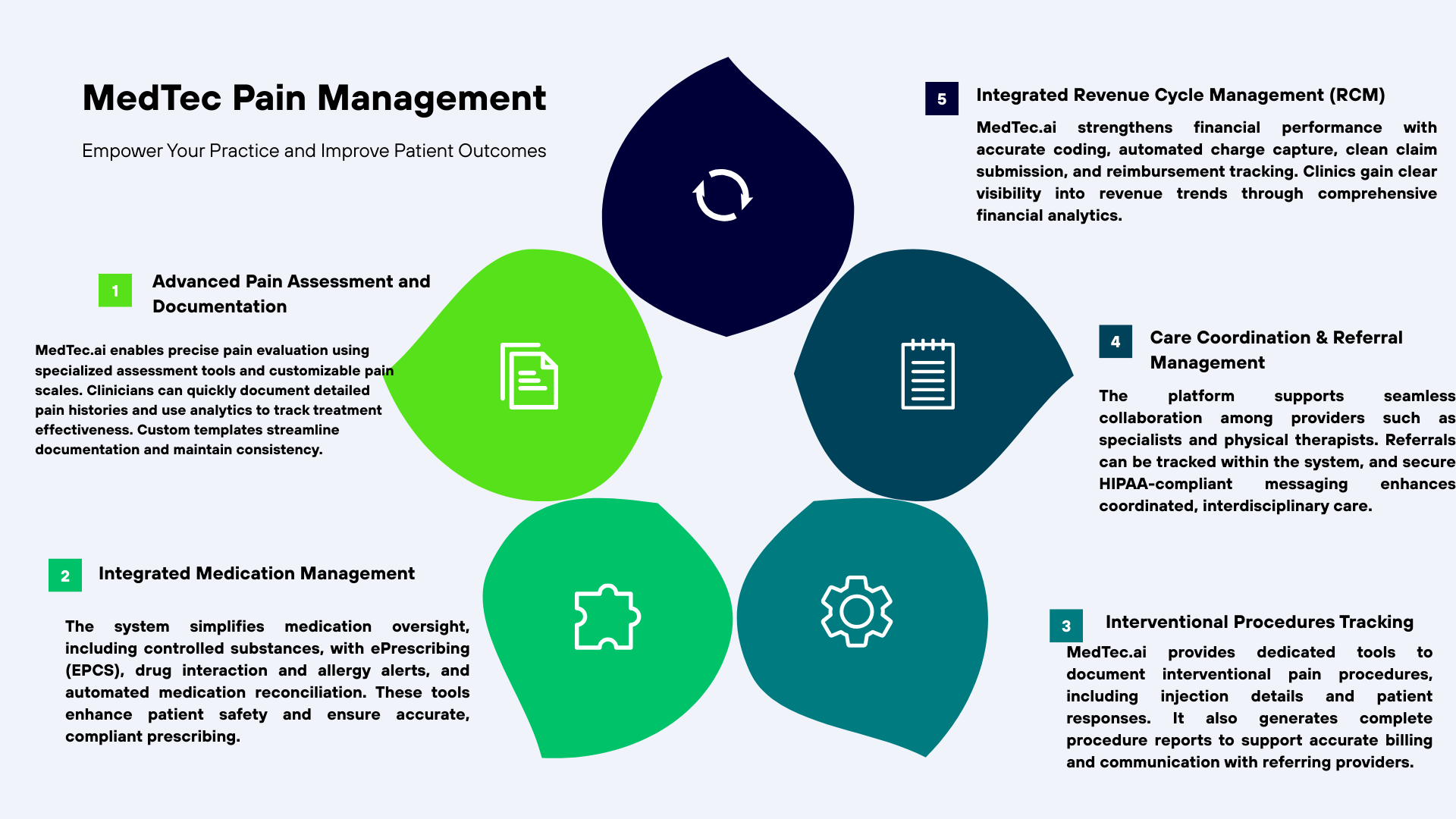
MedTec.ai's EHR is built with direct input from pain management professionals, ensuring the system aligns with real clinical workflows. Its most impactful features include:
Customizable Pain Templates and Documentation
The system includes ready-to-use templates tailored to common pain management encounters—such as chronic pain evaluations, follow-ups, and interventional procedures. These templates allow clinicians to capture details like pain location, intensity, quality, triggers, and functional impact. Providers can also customize fields to match their specific workflow, ensuring consistent and complete documentation while saving time.
Integrated Pain Scales and Assessment Tools
Pain scoring is central to pain management, so MedTec integrates widely used tools such as the Numeric Rating Scale (0–10), the Visual Analog Scale, and the Oswestry Disability Index. Clinicians can chart pain levels over time and incorporate specialized questionnaires related to functionality and mental health. This helps providers measure progress objectively and adjust treatment plans using data-driven insights.
ePrescribing and Medication Management (EPCS Enabled)
Pain management often involves complex medication regimens. MedTec's medication module supports secure electronic prescribing—including full EPCS compliance for controlled substances. The system checks for allergies, interactions, dosage issues, and duplicate prescriptions. It also integrates with state Prescription Drug Monitoring Programs (PDMPs) to ensure safe and compliant opioid prescribing.
Treatment Plan Tracking and Follow-Up
Providers can create long-term, goal-oriented treatment plans that combine medications, procedures, therapy, and lifestyle recommendations. The EHR tracks each intervention, monitors patient progress, and prompts clinicians when reassessments or routine follow-ups are due. This ensures no step in the patient's care journey is overlooked.
Advanced Reporting and Analytics
MedTec's reporting capabilities transform patient data into actionable insights. Clinics can monitor patient outcomes, analyze treatment effectiveness, track pain score improvements, and generate required quality-measure reports for programs such as MIPS or MACRA. Administrative analytics, including billing and reimbursement reporting, help practices maintain financial health alongside clinical excellence.
Additional features include procedure-specific documentation tools, integrated imaging and lab capabilities, and clinical decision support informed by evidence-based pain treatment guidelines.
How MedTec's EHR Improves Patient Outcomes
MedTec's EHR is more than a productivity tool—it directly contributes to clinical improvement. By centralizing patient information, reducing documentation gaps, and enhancing decision-making, providers can deliver safer, faster, and higher-quality care.
Modern EHR systems have been shown to reduce medication harm and improve patient outcomes by supporting accurate prescribing and monitoring. In pain management, this is especially vital. Features like real-time medication alerts, PDMP integration, and detailed pain history tracking help clinicians avoid unsafe drug combinations, identify potential misuse, and ensure patients receive the most appropriate therapies.
The system's ability to visualize pain trends and treatment responses allows clinicians to adjust care plans quickly. Instead of relying on patient recollection, providers can reference objective data—leading to more precise diagnoses and more effective interventions.
Care coordination also improves. MedTec supports seamless communication among pain specialists, referring providers, physical therapists, and behavioral health professionals. When every member of the care team has access to up-to-date information, treatment becomes more cohesive, efficient, and effective. Clinics using specialty EHRs consistently report more accurate diagnoses, safer prescribing habits, and improved patient recovery times.
Streamlining Clinical and Administrative Operations
Pain management practices handle a high volume of clinical activities and administrative tasks. MedTec's EHR is designed to simplify both.
A built-in scheduling module helps front-office staff manage appointments, recurring therapy visits, and procedure blocks with ease. Cloud-based access allows clinicians to review charts and complete notes anywhere. Templates and automation reduce documentation time significantly, minimizing after-hours charting.
Revenue cycle management is fully integrated into the system. As encounters are documented, billing codes and charges are captured automatically, claims are scrubbed for errors, and submissions are streamlined. This reduces claim denials, accelerates reimbursement, and minimizes administrative workload.
These operational improvements ultimately enhance the patient experience. Faster check-ins, fewer paperwork delays, smoother billing communications, and better-coordinated care all contribute to higher satisfaction and shorter wait times.
Supporting Patient Education and Remote Care
Patient engagement plays a major role in successful pain management. MedTec's EHR includes tools designed to keep patients informed, connected, and proactive in their care.
The patient portal provides secure access to visit summaries, treatment plans, and test results. Research shows that patients who engage with their medical information are more likely to follow treatment recommendations and achieve better outcomes. Patients can send secure messages to their care team, ask questions, and clarify instructions between visits.
Educational resources—such as information on pain self-management strategies, exercises, and medication guidance—can be shared through the portal, allowing patients to take an active role in managing their symptoms.
Telehealth features enable remote visits, making care more accessible for patients with mobility challenges or severe pain. Patients can also submit daily pain ratings or symptom updates through the portal, allowing clinicians to monitor progress in real time and intervene early if necessary.
Automated reminders for appointments, medication refills, and follow-ups help patients stay on track with their treatment plans. Satisfaction surveys give practices insight into the patient experience and opportunities for continuous improvement.
Training, Support, and Ease of Adoption
MedTec.ai places strong emphasis on usability and provider support. The system's interface is intuitive, mirrors real clinical workflows, and minimizes unnecessary clicks—allowing clinicians to navigate efficiently even if they are not experienced with technology.
The company offers comprehensive onboarding, including tailored configuration, live training sessions, online tutorials, and support during go-live. This ensures that all staff—physicians, nurses, and administrative teams—can use the system confidently and effectively from the start.
Ongoing support includes regular software updates, regulatory compliance adjustments, and access to a dedicated support team for troubleshooting. MedTec's approach treats the EHR not as a standalone product but as an ongoing partnership that evolves with the needs of each practice.
Conclusion
Pain management requires coordination, precision, and continuous monitoring—demands that traditional EHR systems often fail to meet. MedTec.ai's specialized pain management EHR provides a comprehensive, intelligent, and intuitive solution designed specifically for the complexities of pain care. Its tailored templates, clinical decision support, integrated pain assessment tools, and robust analytics help clinicians deliver safer, more effective, and more personalized treatment. At the same time, its administrative and operational features streamline daily workflows and enhance patient engagement.
For pain management specialists seeking a powerful, user-friendly system that improves both clinical outcomes and practice efficiency, MedTec.ai offers a transformative solution. Healthcare leaders and pain clinic teams are invited to experience the platform firsthand through a personalized demo.