
In the fast-paced world of family medicine, where physicians juggle everything from routine check-ups to managing chronic conditions across all age groups, administrative overload and fragmented patient data can quickly turn a rewarding career into a burdensome one. Imagine spending more time wrestling with paperwork than building meaningful patient relationships, it’s a reality for many family practitioners today. According to recent reports, primary care physicians face significant administrative burdens due to insurance rules and value-based payment implementations, contributing to widespread burnout. Enter Electronic Health Records (EHR) systems: a transformative technology that streamlines workflows, enhances patient outcomes, and restores balance to family practices. As a leading provider of all-in-one EHR and medical billing solutions, MedTec.ai is at the forefront of empowering family medicine professionals to deliver high-quality care efficiently.
This blog post explores how EHR technology addresses the unique demands of family medicine, drawing on real-world insights and data to highlight its impact. Whether you’re a family physician seeking to optimize your practice or a healthcare administrator evaluating solutions, you’ll discover actionable strategies to leverage EHR for better results.
Challenges in Family Medicine Practices
Family medicine serves as the cornerstone of primary care, providing comprehensive, continuous care to individuals and families. However, this broad scope comes with inherent challenges that can strain resources and affect care quality.
One major issue is administrative burden. Family physicians often spend excessive time on documentation, billing, and compliance tasks. Statistics show that persistent underfinancing of primary care exacerbates these problems, leading to inefficiencies and clinician dissatisfaction. For instance, inadequate reimbursement rates drive burnout, with many physicians reporting high levels of stress from competing for limited resources.
Another challenge is patient engagement and adherence. With diverse patient populations, from pediatrics to geriatrics, ensuring consistent follow-up and education is tough. Patients may forget appointments or struggle with treatment plans, leading to poorer health outcomes.
Workforce shortages and retention add to the strain. Data indicate a range of 78,070 to 79,464 practicing family physicians annually in the U.S., but maldistribution and shortages persist, particularly in rural areas. This is compounded by trends toward part-time practice or early retirement due to mounting pressures.
Financial pressures, including declining private practice ownership, now at historic lows with only about half of physicians in practices they own, further complicate operations. Evolving practice models and technological demands in 2025 only intensify these issues.
Finally, coordinating care across specialties is a hurdle. Family physicians often act as care coordinators, but manual processes for referrals, labs, and imaging can delay treatments and increase errors.
These challenges underscore the need for innovative solutions like EHR systems to alleviate burdens and enhance care delivery.
How EHR Technology Addresses Challenges in Family Medicine
EHR systems are more than digital filing cabinets; they’re integrated platforms that tackle family medicine’s pain points head-on. MedTec.ai’s EHR solution, tailored for family practices, exemplifies this by offering customizable tools that streamline operations from charting to billing.
Streamlining Documentation and Clinical Workflows
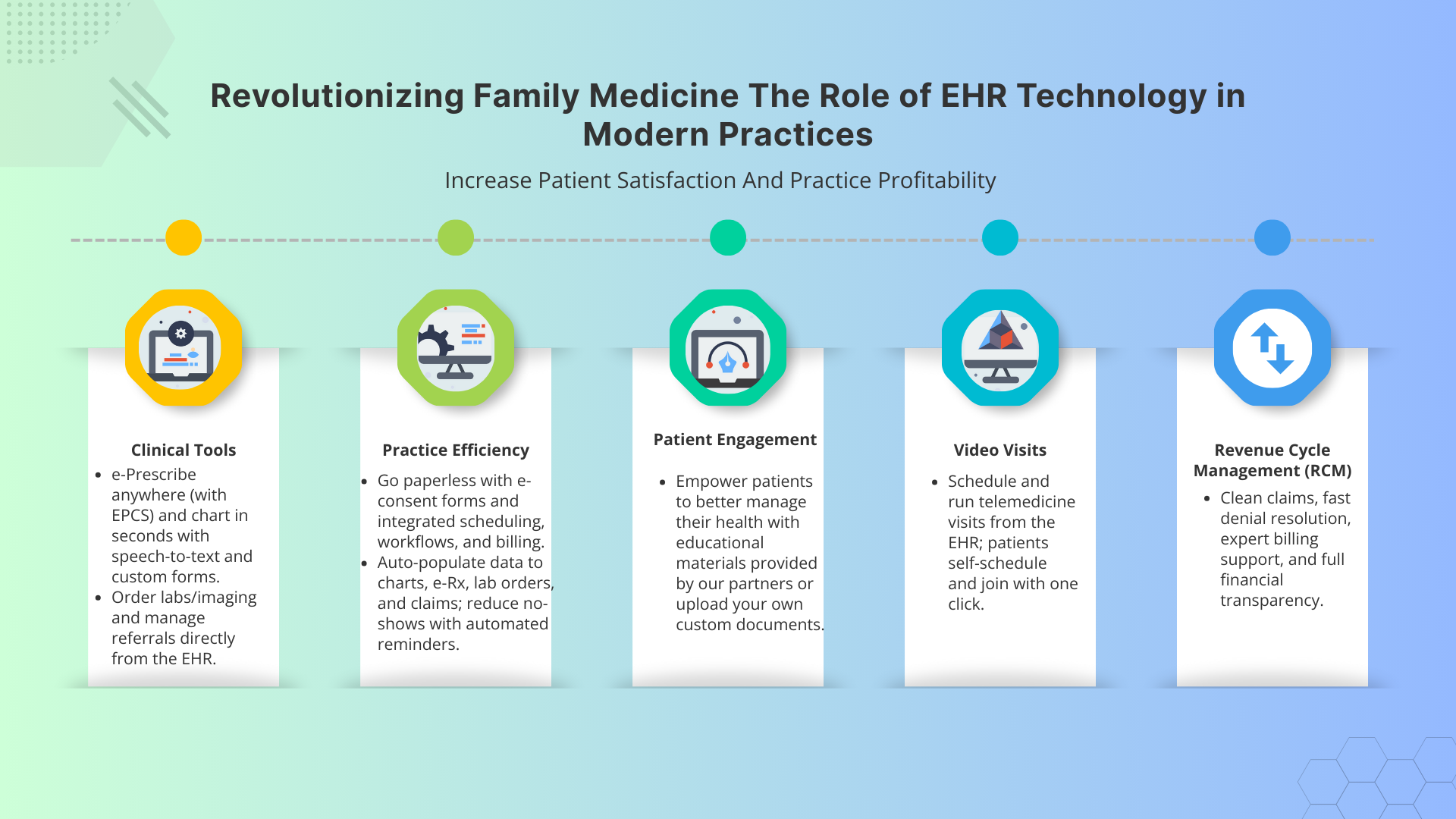
In family medicine, where encounters vary widely, efficient charting is crucial. Traditional paper-based systems lead to time-consuming data entry, but EHRs automate this process. With MedTec.ai, physicians can chart in seconds using medical speech-to-text, drawing tools, and customizable forms that accelerate note-taking.
For example, auto-populating patient information into clinical charts, e-prescriptions, lab orders, and medical claims saves hours weekly. This directly combats administrative burden, allowing more focus on patient interactions. Studies confirm that EHRs improve decision-making through quick access to patient data.
Enhancing Prescription and Order Management
Prescribing medications, especially controlled substances, requires precision and compliance. MedTec.ai’s eRx with EPCS enables e-prescribing from any device, iPad, iPhone, or web, anytime, anywhere. This reduces errors and speeds up processes.
Similarly, placing lab and imaging orders directly from the EHR app, with results integrating into patient charts, eliminates manual tracking. Referral management is simplified, too, with eFax for signing off on forms within the app. These features address care coordination challenges, ensuring seamless handoffs to specialists.
Optimizing Patient Onboarding and Engagement
Going paperless is a game-changer for family practices. MedTec.ai allows sending electronic consent forms and instructions, streamlining onboarding. Automated reminders via text, email, or phone calls reduce no-shows, a common issue in busy practices.
The patient portal enhances engagement by enabling secure, HIPAA-compliant messaging, access to educational materials, and self-management tools. Patients can view their records, which studies show reduces anxiety and improves adherence. This fosters stronger doctor-patient relationships, vital in family medicine.
Facilitating Family Medicine Workflows: Telemedicine and Virtual Care
The rise of remote care has been accelerated by post-pandemic needs, and EHR-integrated video visits are essential. MedTec.ai lets physicians schedule and conduct visits directly from the platform, without extra integrations. Patients can self-schedule in-person or video appointments via the portal, receiving links without setup hassles.
Converting in-person visits to video with one click adds flexibility, especially for families with mobility issues or in rural areas. This addresses workforce maldistribution by extending reach without physical presence.
Improving Revenue Cycle Management (RCM)
Financial viability is key for sustaining family practices. MedTec.ai’s integrated RCM optimizes claims processing, addressing denials within 24 hours for faster payments. Direct communication with billing experts trained in family medicine coding ensures accuracy.
Transparent financial dashboards provide insights into practice health, helping navigate reimbursement challenges. By producing clean claims and timely statements, EHRs maximize revenue, countering underfinancing issues.
Overall, EHR adoption in family practices has surged, with 88% of office-based physicians using any EHR system and 78% adopting certified ones as of 2021—rates even higher among family physicians today. MedTec.ai’s end-to-end system integrates scheduling, workflows, and billing, making it a comprehensive solution.
Benefits and Actionable Insights for Family Practices
Implementing an EHR like MedTec.ai yields tangible benefits that boost both patient satisfaction and practice profitability. Here are key advantages, supported by data:
- Improved Patient Care Quality: EHRs reduce duplication of tests and treatment delays, leading to safer care. Six in ten physicians agree that EHRs enhance patient care overall. In family medicine, this means better management of chronic diseases like diabetes or hypertension through integrated data.
- Increased Efficiency and Reduced Burnout: By automating tedious tasks, EHRs free up time, potentially reducing administrative hours by up to 20-30%. This combats burnout, with features like speech-to-text making documentation effortless.
- Enhanced Patient Satisfaction: Tools like portals and reminders improve adherence and communication. Patients report positive impacts on consultations and relationships with providers.
- Financial Gains: Optimized RCM leads to faster reimbursements and fewer denials, increasing profitability. Practices using integrated systems see revenue boosts from clean claims.
- Data-Driven Insights: EHRs support meaningful use criteria, with 60% of family physicians having systems that enable quality reporting and research participation.
Actionable Insights:
- Assess Your Current Workflow: Audit time spent on admin tasks. If it’s over 50% of your day, consider EHR migration. Start by scheduling a free consultation with MedTec.ai to evaluate your needs at https://medtec.ai/make-appointment/
- Prioritize Patient Portal Adoption: Encourage portal use for messaging and education. Track engagement metrics to refine materials, boosting adherence by 15-20%.
- Integrate Telemedicine Seamlessly: Train staff on video visits to handle hybrid models. This can expand your patient base, especially in underserved areas.
- Monitor Financial Health: Use EHR dashboards for real-time insights. Set alerts for claim denials and review quarterly with billing experts.
- Train for Customization: Leverage customizable forms to fit your practice’s unique needs, like pediatric growth charts or geriatric assessments.
To experience these benefits firsthand, schedule a demo of MedTec.ai’s EHR system today at https://medtec.ai/make-appointment/. Our experts will show how it can transform your family practice.
Future Trends in EHR for Family Medicine: AI Integration and Beyond
As we look to 2025 and beyond, EHR technology is evolving rapidly, with AI at the helm. Integration of artificial intelligence promises to elevate family medicine by automating complex tasks and providing predictive insights.
One trend is AI-driven documentation. Future EHRs will use advanced AI to generate accurate notes from speech, understanding clinical context and reducing manual entry. This builds on MedTec.ai’s speech-to-text, potentially cutting charting time by half.
Interoperability and Cloud-Based Systems will enhance data sharing across providers, crucial for family medicine’s coordinating role. Cloud EHRs offer scalability and security, with trends toward seamless integration.
AI for Predictive Analytics: In primary care, AI can forecast patient risks, like disease outbreaks or non-adherence, enabling proactive interventions. eConsults combined with AI will address costs and access issues.
Agentic AI Assistance: By 2025, AI agents will handle clinical coding and workflow automation, freeing physicians for patient care. Hospital adoption of AI in EHRs is rising, with use cases like sepsis detection extending to family practices.
Generative AI in systems like Epic is maturing, with features for note summarization and patient messaging. MedTec.ai is poised to incorporate these, ensuring family practices stay ahead.
AI tools have supplanted EHR usability as the top tech priority for medical leaders in 2025, signaling a shift toward intelligent systems. Embracing these trends will not only mitigate challenges but propel family medicine into a more efficient, patient-centered future.
Embrace EHR for a Thriving Family Practice
Family medicine is pivotal to healthcare, but its challenges, from administrative burdens to engagement gaps, demand innovative solutions. EHR technology, as exemplified by MedTec.ai’s all-in-one platform, addresses these by streamlining workflows, boosting engagement, and maximizing revenue. With adoption rates nearing 90% and proven benefits like improved care quality and reduced errors, EHRs are indispensable.
Looking ahead, AI integration will further revolutionize the field, making practices more predictive and efficient. As a trusted leader in healthcare technology, MedTec.ai empowers family physicians to focus on what matters: exceptional patient care.
Promote your family medicine practice with MedTec.ai’s cutting-edge EHR platform, unlock efficiency, engagement, and growth. Sign up now at https://medtec.ai/ to get started and elevate your healthcare delivery today! Your future in family medicine starts here.